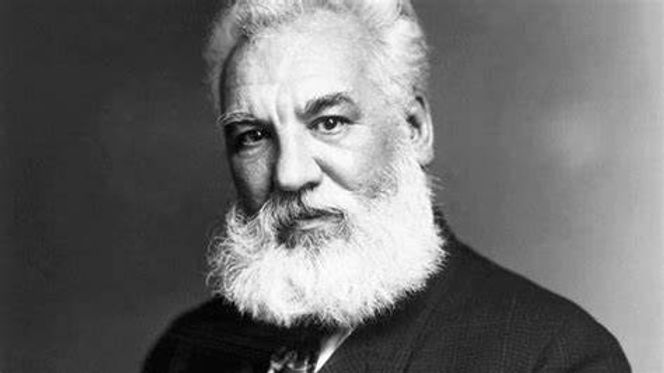
Alexander Graham Bell
and the
Tale of the Telephone
The American Industrial Revolution paved the way for a multitude of inventors and inventions that would change the course of history forever. Alexander Graham Bell is one of many inventors during this time who contributed to the numerous amounts of technological advances with his formulation of the first practical telephone.
Born in Edinburgh, Scotland in 1847, Bell’s life was heavily influenced by his father, grandfather, and uncle who all specialized in work revolving around elocution and speech. Bell’s mother was also deaf, which contributed to his passion for the value of speech. These influences would later inspire Bell to experiment with hearing devices and the alike, eventually leading him to the first United States patent for the telephone (Hatton, 2002).
THE LIFE & EDUCATION OF ALEXANDER GRAHAM BELL
CONTENTS
Alexander Graham Bell, a product of Alexander Melville Bell and Eliza Grace Symonds, was shaped into one of the most talented inventors of his time, solely based off his life experiences, events, and situations.
Alexander Graham Bell’s father’s work concentrated on the idea of developing a form of ‘visible speech’, which would allow for speech sounds to be written down. The goal of the visuals was to teach deaf people to speak, without the ability to hear spoken word. Bell’s fathers work impacted his life in many ways, eventually leading Alexander Graham Bell to further experiment with the ideas of creating a mechanical speech device (“Alexander Graham Bell’s Box Telephone,”n.d.).
Although Alexander Graham Bell had a significant passion for these concepts of speech, the lackluster and obligatory nature of schooling never appealed to Bell. After attending the Royal High School at Edinburgh at age 11, he inevitably left school without graduating at the age of 15. Although Bell had not received his high school diploma and had only a mere four years of public education on top of his homeschooling, he was able to attend University College London in 1868 after passing the required entrance exams (Hochfelder,1999).
Following the death of his two brothers, Alexander Graham Bell was unable to complete his studies at the university, due to his family immigrating to Canada. Shortly after Bell’s family moved to Ontario, Alexander moved to Boston to teach at the Boston School for Deaf Mutes. Bell went on to teach at multiple universities, where he eventually met and fell in love with his wife Mabel Hubbard.

Alexander Graham Bell, pictured with his wife Mabel Hubbard and two daughters Marian and Elsie Bell.
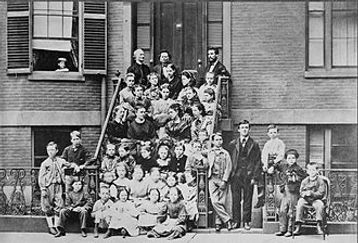
Alexander Graham Bell pictured with teachers and students at the Boston School for Deaf Mutes.
ALEXANDER GRAHAM BELL AND THE TELEPHONE
Amid pursuing his career teaching, Alexander Graham Bell began to research ways to transmit multiple telegraph messages over a single wire at the same time. In turn, his extensive research regarding the telegraph inspired and paved the way for Bell’s invention of the telephone.
Bell had experimented with ideas regarding a “multiple telegraph”, in which him and his rival Elisha Gray, developed outlines that were capable of dividing a single telegraph line into various channels. As a result of their designs and the potential that they held, an investor by the name of Gardiner Hubbard decided to fund Bell’s experiments toward creating a harmonic telegraph. However, unbeknownst to Hubbard, Alexander Graham Bell was working with an electrician by the name of Thomas Watson to develop a device that is capable of transmitting speech electrically (“Telephone and Multiple Telegraph,” n.d.). Alexander Graham Bell was later encouraged by Hubbard to file for patents for his ideas surrounding the harmonic telegraph. Eventually, Hubbard and Thomas Watson then became a financer and founder of the Bell Telephone Company.
Although Alexander Graham Bell is credited with the invention of the telephone, there is much controversy surrounding the exchange at the patent office and whether or not Bell should truly be the individual recognized for the invention. Elisha Gray was one of Alexander Graham Bell’s biggest competitors, as they both experimented in similar lines of work. Gray, who was an employee for the Western Electric Company, and Bell were both working toward creating their own versions of the telephone (Hatton, 2002).
As you can imagine, it was a race between Gray and Bell to the patent office. Elisha Gray and Alexander Graham Bell had filed for rights to similar inventions on February 14,1876. Alexander Graham Bell had filed for a patent for the telephone, while Gray had filed for a caveat. Elisha Gray had filed his caveat earlier that day and there is suspicion surrounding the patent officer, Zenas Fisk Wilber, for allowing Bell to preview Elisha Grays’s caveat.
Inevitably, Alexander Graham Bell was granted the patent for the telephone on March 7, 1876. His partner, Thomas Watson, was the first person to hear a human voice via telephone, where Bell said “Mr. Watson, come here, I want you!”. In the months to come, Bell had attended the 1876 Centennial Exposition in Philadelphia, where he held his first public demonstration of the telephone in hopes of further marketing his invention.
The invention of the telephone has shaped our lives in many different ways. Communication is so readily available to us in today’s society that we often do not realize the privilege we have succeeding the invention of the telephone. Without the great works of Alexander Graham Bell, humans would not be able to interact with one another as effectively or efficiently as we can today. The telephone is a timeless invention that has shifted the course of history forever and will continue to modernize and excel in the future.

Bell's experimental telephone, consisting of both a transmitter and receiver.
